The Real Cost of Not Understanding Google Analytics
7 May 2026
|
 by
Connor
by
Connor
Most businesses do not have a shortage of marketing data. They have dashboards, campaign reports, website numbers, agency updates and, quite often, a colour-coded spreadsheet that creates the reassuring impression that everything is under control.
What they often lack is something much more commercially useful: confidence.
Confidence that the numbers are right. Confidence that the team is looking at the right things. Confidence that budget is going into activity that actually helps the business grow.
That is where the real cost of not understanding Google Analytics starts to show.
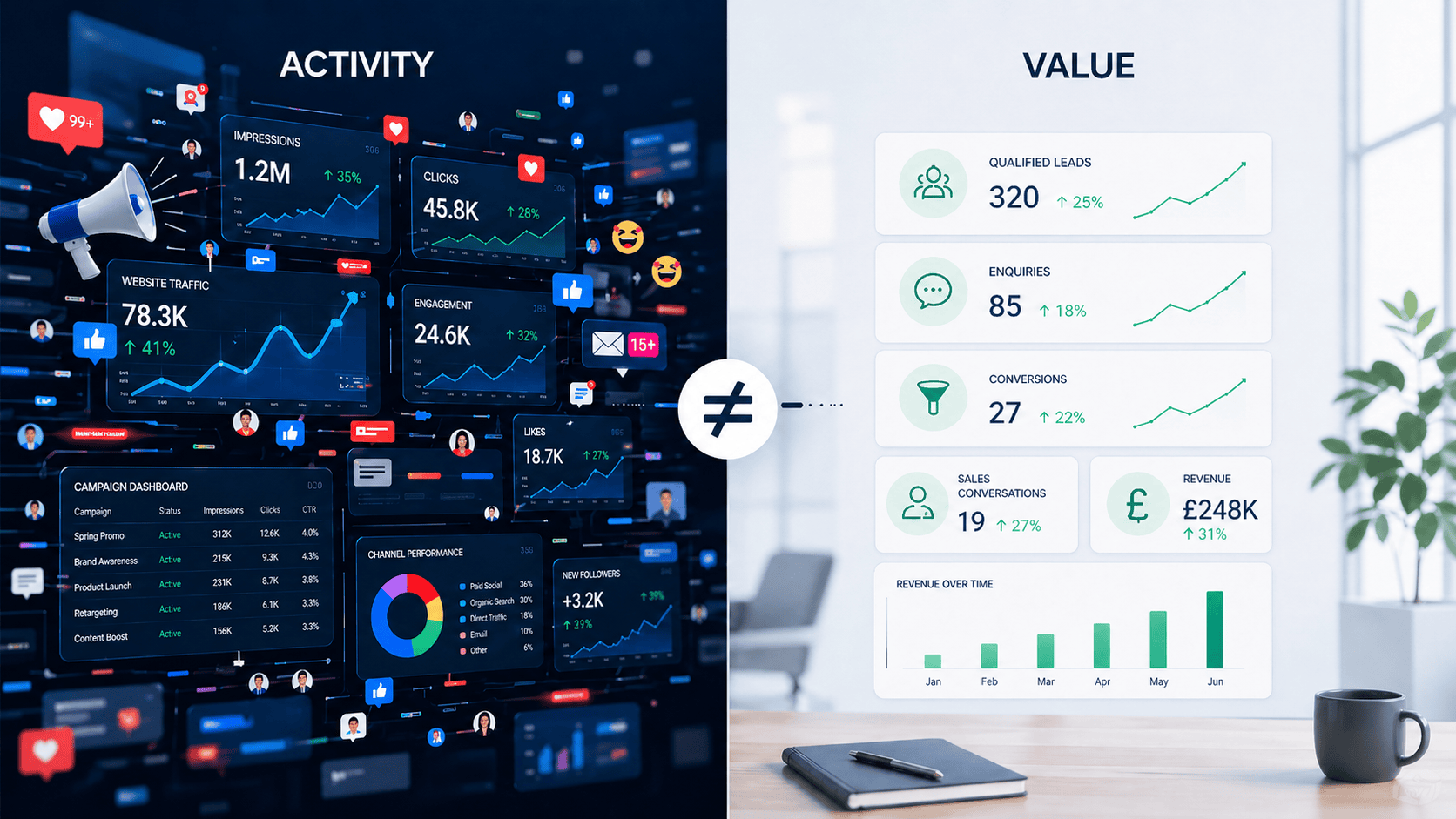
Imagine your team spent £3,000 on a LinkedIn campaign last quarter. The campaign looked active. It generated impressions, clicks and engagement. The creative was strong, the posts went out on time, and the report looked positive enough at first glance.
Then someone in a senior meeting asks the awkward question: “What did it generate?”
Not how many people saw it. Not how many people clicked. What did it actually generate for the business? Leads? Enquiries? Sales conversations? Newsletter sign-ups? Anything that helps justify the time and money spent?
If no one in the room can answer clearly, the problem is not simply a reporting gap. It is a financial risk. When a business does not understand Google Analytics, it risks wasting budget, backing the wrong campaigns, undervaluing the right ones and making decisions based on assumptions rather than evidence.
And that can get expensive very quickly.
Google Analytics may be free. Misunderstanding it is not.
One of the most misleading things about Google Analytics is that, for many organisations, the platform itself does not come with a direct monthly cost. That can make it feel like a low-risk tool. After all, if Google Analytics is free, where is the harm in muddling through?
The harm is not usually in the software cost. It is in the decisions made around the data.
If your team misreads performance, the cost appears somewhere else. It shows up in advertising budgets spent on channels that are not converting. It shows up in content that takes days to produce, but does not support the customer journey. It shows up in campaigns that cannot be properly attributed. It shows up in reports that create activity, but not clarity.
GA4 is not just a place to check how many people visited your website. Used well, it can help a business understand where valuable audiences are coming from, what they do when they arrive, which content supports conversion, and which marketing activity deserves more investment.
But having access to GA4 is not the same as understanding it.
Many organisations have GA4 installed. They receive reports. Someone on the team can find top-line traffic numbers when asked. The problem starts when the conversation moves from “how many users did we get?” to “what should we do next?”
That is the difference between data and useful insight.
Understanding Google Analytics means being able to connect numbers to decisions. It means your team can answer practical business questions: which channels are bringing in valuable visitors? Which campaigns are creating enquiries or sales? Which pages help people take action? Which content attracts the wrong audience? Where are potential customers dropping out?
For senior leaders, this distinction matters. A managing director, head of marketing or business owner does not need to know every detail of GA4 configuration. But they do need a team that can use marketing management analytics to support better decisions.
Where the cost starts to show
The cost of poor Google Analytics understanding rarely appears as one neat line in a budget. It tends to spread across campaigns, content, reporting, staff time and missed opportunities.
That is what makes it so easy to overlook.
Wasted advertising spend
Paid media is often where poor analytics understanding becomes most expensive. A campaign can look successful in the platform where it was launched, with plenty of impressions, clicks and engagement, all while contributing very little to the business.
If those visitors do not view key pages, return later, complete meaningful actions or become useful leads, the campaign may be generating activity rather than value. This is where data analytics for decision-making becomes more than a phrase. It becomes the difference between reallocating budget intelligently and continuing to spend because a report looks busy.
The waste is not always dramatic. More often, it is a slow leak: a few hundred pounds a month spent on the wrong audience, a campaign that drives traffic but not enquiries, or promoted content that no one can connect to a useful business outcome.
Left unchallenged, those small leaks become a sizeable annual cost.
Content with no feedback loop
Most organisations now invest heavily in content. Blog articles, landing pages, case studies, downloadable guides, videos, email newsletters and social posts all take time to plan, produce and approve. Some require an external budget. Many involve input from senior people whose time is already stretched.
Yet many businesses still judge content performance by the easiest numbers to find. Page views, time on page, social engagement and newsletter clicks can all be useful, but they rarely tell the full story.
A blog post with high traffic may bring in visitors who are never likely to buy. A niche service page with modest traffic may be quietly helping high-intent prospects make contact. A case study may not get thousands of views, but it might be the page people visit before submitting an enquiry.
Without a proper analytics strategy, businesses can end up investing in the content that looks popular rather than the content that supports commercial goals.
Campaigns that cannot be attributed
Attribution is where many marketing conversations become uncomfortable.
A campaign goes live. The team promotes it through email, social media, paid ads, partner channels and perhaps a PR push. Website traffic increases. A few enquiries come in. Everyone feels that the campaign probably helped.
But how much did it help? Which channel did the heavy lifting? Which activity introduced people to the business? Which touchpoint brought them back?
If links are not tagged consistently, events are not properly understood, conversions are not clearly defined, or GA4 reports are misread, the business is left with a blurred picture. That matters because attribution affects future investment.
Email may be undervalued because it has not been tagged properly. Paid social may be cut too quickly because its role was earlier in the customer journey. “Direct” traffic may be inflated because campaign links have not been tracked clearly.
Poor attribution does not just make reporting untidy. It changes budget decisions.
Decisions made on assumption
When people do not trust the data, something else fills the gap. Usually, it is an opinion.
That opinion might come from experience, which can be valuable. It might come from a senior stakeholder, who can be influential. It might come from habit: “We always run this campaign.” It might come from competitor activity: “They are doing more on TikTok, so perhaps we should too.”
The problem is not that instinct has no place in marketing. It does. The problem is when instinct has no challenge.
Without reliable analytics, businesses can end up making decisions based on the loudest voice in the room rather than the clearest evidence. They may continue investing in a familiar channel because it feels safe. They may redesign a website because someone dislikes the current one. They may cut a campaign that appears weak on last-click conversions, even though it plays an important role earlier in the customer journey.
Good analytics does not remove judgment. It improves it.
Reports that do not change anything
A monthly marketing report should make decisions easier. Too often, it does the opposite.
The report arrives with pages of numbers. Users are up. Sessions are down. Engagement rate has changed. Some campaigns have performed better than others. There are charts, percentages and perhaps a short written summary.
But after all that reporting, the leadership team is still left wondering: Is this good? Should we spend more? Should we stop something? What needs attention?
This is a common symptom of poor analytics understanding. Reporting becomes a process rather than a decision-making tool. The team reports what GA4 shows, rather than using GA4 to answer the questions the business actually cares about.
There is a big difference between saying, “Website traffic increased by 12% last month,” and saying, “Organic search generated 36 qualified enquiries last month, with most coming from three service pages.”
The first statement is a statistic. The second is insight.
The warning signs are often hiding in plain sight. No one can agree on what a conversion actually is. Reports focus mainly on users, sessions and page views. Campaign links are created inconsistently. Senior leaders do not trust the numbers. GA4 is only opened when a monthly report is due.
Perhaps the most telling sign is vagueness. Someone asks what a campaign delivered, which content influenced enquiries, or why one channel deserves more budget than another, and the answer becomes woolly.
That vagueness has a cost.
Why this is a training issue, not just a reporting issue
It is tempting to think the answer is a better dashboard. Sometimes, that helps. A well-designed dashboard can save time, focus attention and make regular reporting easier. But a dashboard does not solve the underlying issue if people do not understand what they are looking at.
The same is true of setup. A technically sound GA4 account is important. If events, conversions and campaign tracking are wrong, the data will be limited from the start. But even a well-configured account only becomes valuable when people know how to interpret it.
This is why GA4 training should not be seen as a technical extra. It is a commercial investment.
Training helps teams understand what GA4 can tell them, what it cannot tell them, and how to use the data to support better decisions. It gives marketers more confidence, helps managers ask sharper questions, reduces reliance on guesswork and makes reporting more useful.
For businesses working with agencies, it also helps internal teams become better clients. They can brief more clearly, evaluate recommendations more confidently and understand whether the activity is aligned with business goals.
For in-house teams, the benefits can be immediate: better decisions about which campaign to continue, which page to improve, which content to promote, which report to challenge and which metric to stop obsessing over.
A GA4-confident team does not need to know everything. The point is that they can ask better questions, find useful evidence and interpret the answers in a business context.
That is the practical value. Not abstract data literacy. Better decisions.
How to estimate the cost in your own organisation
The real cost of poor analytics understanding will vary from business to business, but it is often easier to estimate than people think.
Start with three questions.
- How much are you spending each month on paid campaigns, content production, SEO, email marketing, social media or agency support?
- How much of that activity can be confidently connected to meaningful outcomes?
- How much time is spent producing reports that do not change decisions?
The answers do not need to be perfect to be useful. If your organisation spends £5,000 a month on campaigns but cannot clearly identify which channels are generating qualified enquiries, even a 10% misallocation represents £500 a month. That is £6,000 a year before you include staff time, agency fees or missed opportunities.
Now add the softer costs. How many hours are spent planning and approving content without knowing what role it plays? How many meetings discuss numbers without reaching conclusions? How often does the same question come up because no one trusts the answer?
The cost of not understanding GA4 is not always visible as a single invoice. It is spread across missed chances, weak decisions and inefficient spending.
That is what makes it so easy to ignore, and so important to address.
The real cost is not the tool. It is the decisions around it.
Google Analytics is not magic. It will not create a marketing strategy on its own. It will not tell you everything about your customers. It will not remove the need for judgment, creativity or commercial experience.
But it can help businesses make better decisions. It can show which activity deserves more attention. It can challenge assumptions. It can reveal gaps in the customer journey. It can help teams understand whether campaigns, content and channels are contributing to real business outcomes.
The problem is that too many organisations have GA4 in place without enough understanding around it. They have the tool, but not the confidence.
And that confidence gap is expensive. It leads to wasted advertising spend, unclear attribution, weak reporting, poor content decisions and strategy shaped by assumption rather than evidence.
For the people responsible for signing off on marketing budgets, that should matter. The question is not whether your business can afford to understand Google Analytics properly.
The better question is: what is it already costing you not to?
Mosaic Media Training’s GA4 training course is designed to help marketing, communications and business teams understand what GA4 is telling them, ask better questions of their data, and make more confident decisions about campaigns, content and budget.

About Connor
AuthorConnor is our in house SEO and digital marketing expert! With a commercial background and experience in scaling businesses, Connor is passionate about website development, analytics and enabling organisations to make the most of their online presence. He’s also a CIM and Google qualified AI marketing specialist.
